


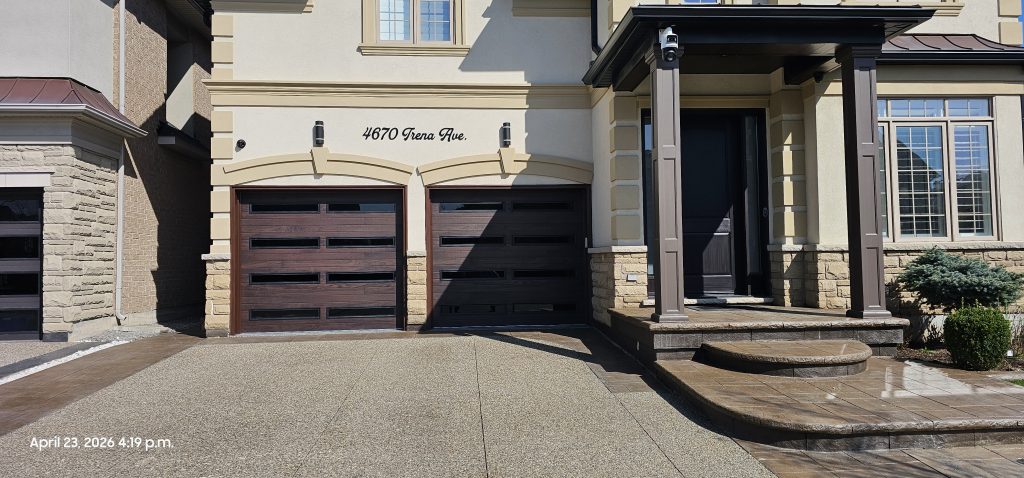
A garage door is one of those things you never think about until it stops working. So how long should yours last — and how do you know when repair money would be better spent on replacement? Here is what we see in the field across Burlington and the GTA.
Typical garage door lifespan
A well-maintained steel garage door typically lasts 20 to 30 years. Springs are different: torsion springs are rated in cycles (usually about 10,000 opens and closes), which works out to 7–12 years for the average family. Openers sit in between at 10–15 years.
7 signs it is time to replace the door
- It needs repairs every year. Once fixes become a routine, the door is telling you something.
- Multiple panels are damaged or rusting. One dented panel can be replaced; widespread rust or cracking cannot be patched economically.
- It is loud, heavy and slow even after tune-ups — a sign the whole system is worn.
- It sags or hangs crooked. Warped sections and stretched cables compromise safety.
- No insulation. If the garage is attached, an uninsulated door leaks heat all winter and drives up energy bills.
- It predates modern safety features like pinch-resistant panels and tamper-resistant bottom brackets.
- Your curb appeal is dated. The garage door can be a third of the front of your home — and replacing it is consistently one of the highest-ROI home upgrades in Canada.
Extend the life you have
Annual maintenance — lubrication, spring and cable inspection, hardware tightening and balance testing — is the single best way to reach that 30-year mark. See our maintenance guide for what a tune-up covers.
What actually wears out, and in what order
A garage door is not one thing with one lifespan. The springs go first, at roughly 10,000 cycles for a standard spring, which is seven to ten years for a typical household. Rollers and hinges are next, usually at ten to fifteen years, and a good set of nylon rollers pushes that out. The opener runs ten to fifteen years. The panels themselves, if they are steel and not badly dented or rusted, can run twenty-five to thirty years. So a twenty-year-old door with a rusty bottom section and an original opener is not one problem, it is three, and they do not all need the same answer.
The repair-or-replace test that actually works
Look at the panels, not the hardware. Everything that moves can be replaced and it is normal to do so. The panels are the only part that cannot be renewed. If the sections are straight, the bottom rail is not rusted through, and nothing is creased from being reversed into, the door is worth keeping and you should fix the hardware. If the bottom section is rusted along the retainer, or a panel is creased so the door binds, you are paying to keep a door alive that will fail again somewhere else, and replacement is the better spend.
How to get the full thirty years out of a steel door
Rinse road salt off the bottom section a few times each winter. Replace the bottom seal when daylight shows under the closed door, before the rust starts. Lubricate hinges, rollers and springs twice a year with a garage door lubricant, not a penetrating oil. Have the balance checked annually, because an unbalanced door makes the opener do the springs’ job and wears both out faster. Replace springs in pairs when the first one goes. None of this is expensive, and together it is the difference between a door that lasts fifteen years and one that lasts thirty.
Talk to a local expert
Not sure whether your door has another decade in it? Pro Entry Garage Doors gives honest, upfront assessments across Burlington and the GTA — and if a repair will do the job, that is what we will recommend. Call 416-666-6745 or explore new door options.